

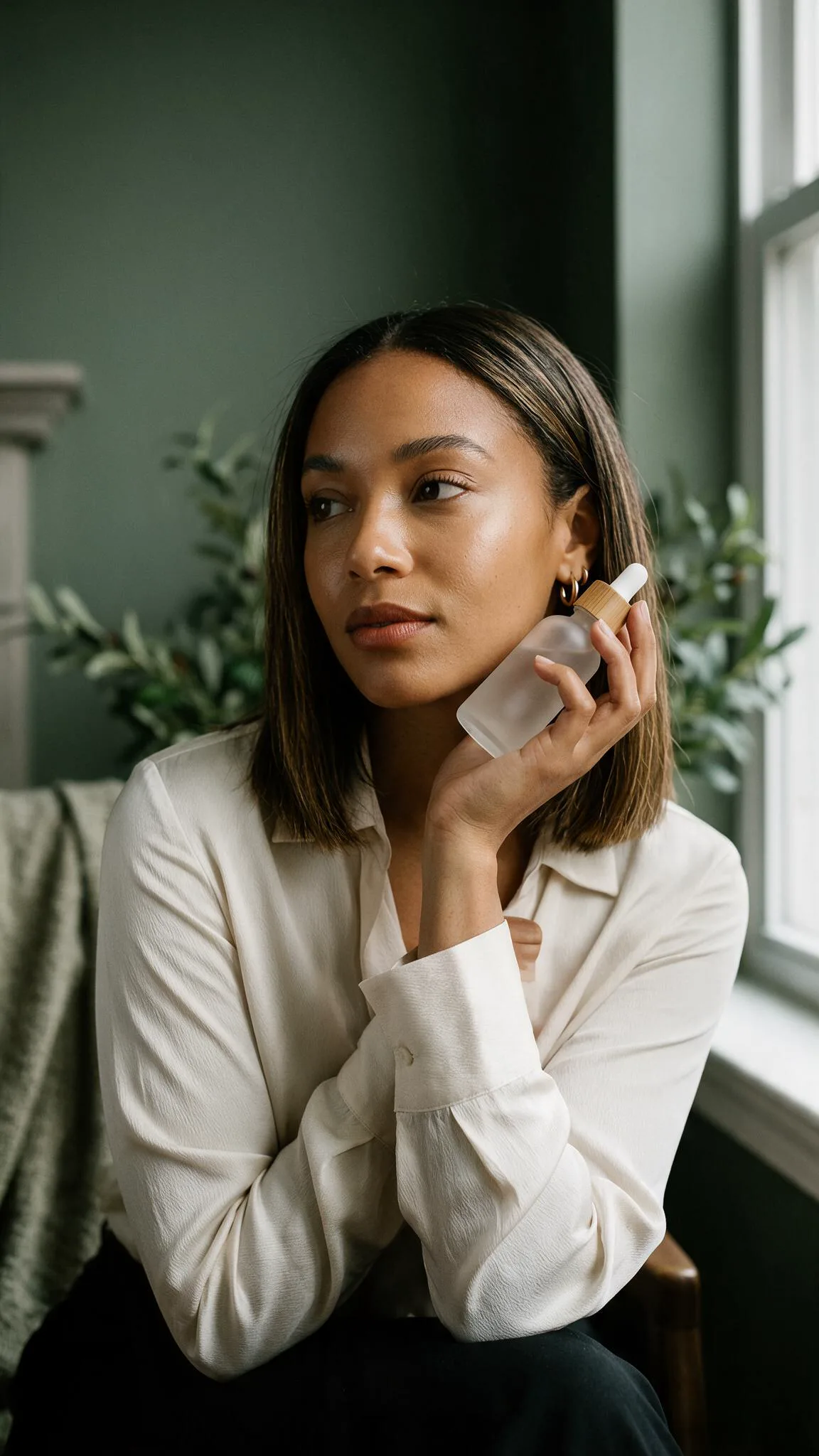
AI can widen what a skincare brand is able to make, as long as the brand stays honest about what it is showing.
What AI does well today
Used with direction, AI tools are good at mood and atmosphere: light moving across silk, water beading on stone, a quiet room at golden hour. They are good at settings and backgrounds, at storyboards that let a team see a film before it is made, and at variations that make testing possible. For an AI content studio for skincare brands, that is the sweet spot: concept and craft, directed by people with taste. It is also a way to explore directions before a shoot, so the real photography day is spent on ideas that already work.
Where it still fails: skin, hands, packaging and claims
AI still stumbles on the things skincare depends on most. Skin can drift lighter, greyer or smoother than life. Hands grow extra fingers or lose them. Packaging text comes out garbled, so the real product should be photographed and placed into the scene. And AI must never be used to show results, because a generated result is a claim no one achieved.
The honesty rules
- No fake reviews or testimonials. The US Federal Trade Commission's final rule banning fake reviews and testimonials, including AI-generated ones attributed to people who do not exist, took effect on 21 October 2024.
- Label where the platform asks. Meta labels detected or disclosed AI content “AI info”, and TikTok requires labels on realistic AI-generated content.
- Consent for any real likeness. Never recreate a real person without their written permission.
- Never an AI before-and-after. Results imagery is real, consented and unretouched, or it is not used.
- Real product, real packaging. The formula and the jar on screen must be the ones the customer receives.
A production workflow, from brief to final cut
- A brief that names the audience, the feeling and the one idea.
- References and casting that cover every shade of skin and a range of hair.
- Directed generation, one change at a time.
- A human review of skin, hands and product at full size.
- Editing, colour and sound.
- A check against each platform's rules before anything is published.
Each step has an owner, and nothing is published until a person has looked at every frame at full size.
Testing AI ads: three hooks across two angles
AI makes it practical to test. A simple structure is three hooks, the first seconds that earn attention, across two angles, the reasons someone might care. That gives six creator-style video ads, and after a fair run you keep what works and retire what does not. Testing tells you what your audience responds to; it cannot promise a result.
What it costs and how long it takes
Cost and time depend on the number of pieces, the finish and the rounds of refinement. At the house, the UGC Ad Pack of six creator-style video ads is USD 1,400, and a Signature AI Brand Film of 45 to 60 seconds, with three cut-downs, is USD 2,500 (CHÉ Services and Investment Guide, valid through 31 March 2027).
AI is a brush, not a painter. The taste, the casting and the honesty remain ours.
Questions, answered
Will customers know the content is AI?
Sometimes, and that is fine when it is labelled and used for mood and concept. What damages trust is pretending AI is real.
Can AI replace product photography?
Not for the product itself. The jar, the texture and the colour should be real, so customers receive what they saw.
Is AI content allowed in ads?
Generally yes, within each platform's rules and labels, and never for fake testimonials or results.
See the UGC Ad Pack in The Bayit System, or book a Brand Evolution Session to plan AI content that stays honest.
Sources
- US Federal Trade Commission (14 August 2024). Federal Trade Commission Announces Final Rule Banning Fake Reviews and Testimonials (effective 21 October 2024).
- Meta (April 2024). Our Approach to Labeling AI-Generated Content and Manipulated Media.
- TikTok Support. AI-generated content.
- Nicoletti, L. and Bass, D. (2023). Humans Are Biased. Generative AI Is Even Worse. Bloomberg.
- CHÉ Services and Investment Guide, valid through 31 March 2027.